 47
47 Residents of Odesa and Dnipropetrovsk regions most often immerse themselves in work and communicate with friends to improve their psychological and emotional state. This is evidenced by the results of a sociological study, which was organized in the summer of 2025 by the Representative Office of the International Solidarity Fund within the framework of the project “Integrated support for war-affected children, families and communities”.
According to the study, in the communities of Dnipropetrovsk region, the index of psychological resilience of residents was 7.13 points, in the communities of Odesa region – 7.04. Both indicators are higher than average (researchers define the average level at 4-7 points).
The involvement of residents of the Odesa region in the active economic and social life of the community, according to the survey, in the economic life of the communities is 32% (for example, participation in budgeting, creating startups, opening their own business, retraining, advanced training, etc.), in social life – 28% (volunteering, participation in local social projects, cultural events, attending trainings, self-development courses, clubs, etc.). In the Dnipropetrovsk region, these indicators are higher and are 37% and 34%, respectively.
Residents of Dnipropetrovsk and Odesa regions demonstrate a significantly higher level of such emotional states as fatigue, tension, confusion compared to Zhytomyr and Rivne regions, where the PRO_MentalHealth psychosocial program is already operating: in particular, 61% of residents of Odesa region noted that fatigue has been prevailing in their mood recently. In Dnipropetrovsk region, this level is slightly higher: 62%. At the same time, in Zhytomyr region, this figure is 53%, and in Rivne region – 45%.
In order to get out of a depressed state, 31% of residents of Odesa region and 33% of residents of Dnipropetrovsk region – indicated that they immerse themselves in work: this is the most common way. In second place was identified communication with friends and relatives (36 and 41%, respectively), in third – doing their favorite thing (24% in both regions).
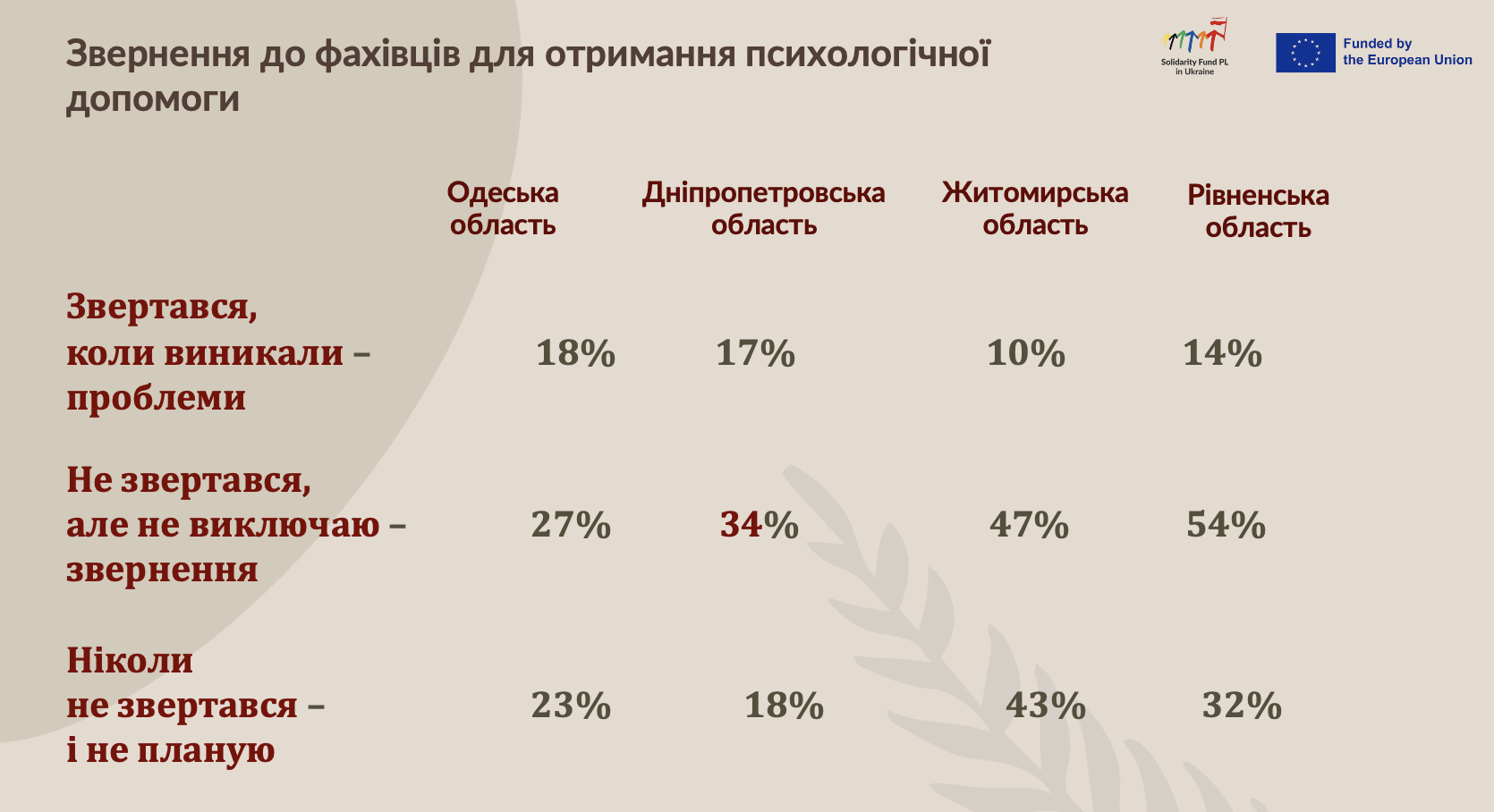
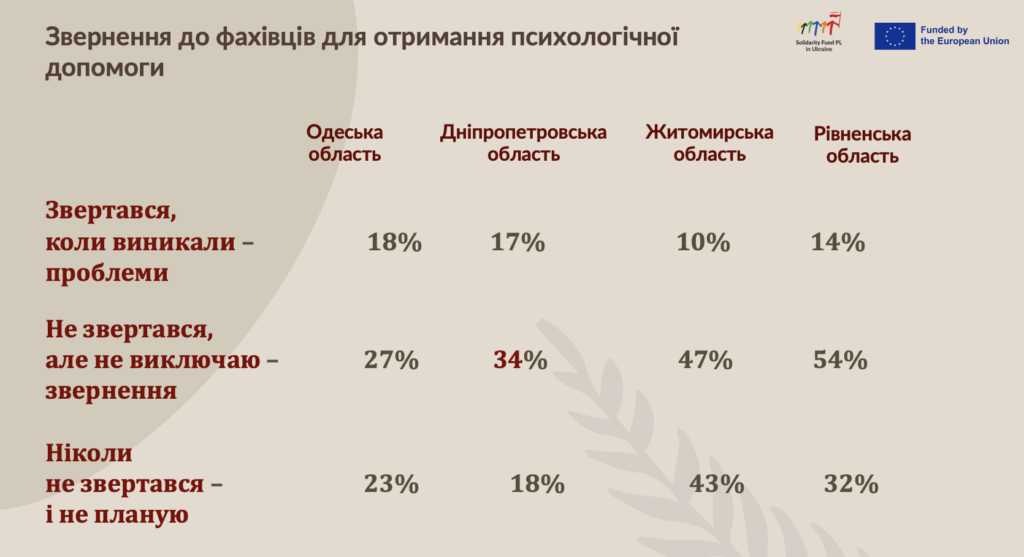
18% of surveyed residents of the Odesa region reported that they had turned to specialists for psychological help when problems arose. In the Dnipropetrovsk region, this figure was 17% (for comparison: in Zhytomyr region – 10%, in Rivne region – 14%). At the same time, 34% of residents of the Dnipropetrovsk region who participated in the study said that they were ready to seek such help if necessary. For the Odesa region, this figure was 27%, for the Zhytomyr region – 47%, for the Rivne region – 54%.
Among the study participants, 56% of residents of the Odesa region noted that the Centers for Psychosocial Support should provide the services of a psychologist or psychotherapist, 44% noted that there should also be assistance from a lawyer, 39% believe that the Centers should, in particular, hold meetings with specialists in various fields (doctor, lawyer, representatives of local government bodies, etc.). Residents of the Dnipropetrovsk region identified the same priorities (64%, 38%, 36%, respectively).
The sociological research aimed to comprehensively assess the level of psychological resilience of residents, their involvement in economic and social life, and to identify needs in the field of psychosocial support. Analysis of the results obtained allowed us to identify key trends and see both differences and common indicators between different regions.
We would like to remind you that this year, within the framework of the project “Integrated support for war-affected children, families and communities”, the Representative Office of the International Solidarity Fund began supporting communities in Dnipropetrovsk and Odesa regions in creating Psychosocial Support Centers. Based on the results of the assessment, the commission decided to select 15 territorial communities in Dnipropetrovsk region and 17 territorial communities in Odessa region to participate in the Grant Program. The next stage will be the formation of district coordination groups (RCGs) from among the selected communities and the organization of RCG meetings to diagnose the needs of communities and study the possibilities for creating Psychosocial Support Centers.
The grant program is designed to increase the capacity of territorial communities in Dnipropetrovsk and Odesa regions to provide psychosocial and physical rehabilitation services to the population affected by the war.
Within the framework of the PRO_MentalHealth Psychosocial Program, four Psychosocial Support Centers have already been established in Rivne region and four in Zhytomyr region.
“Integrated support for war-affected children, families and communities” Project is funded by the European Union and implemented by the Solidarity Fund PL in Ukraine in frames of PRO_MentalHealth Psychosocial Support Programme.